Categories
Best Five Journal Wisdom

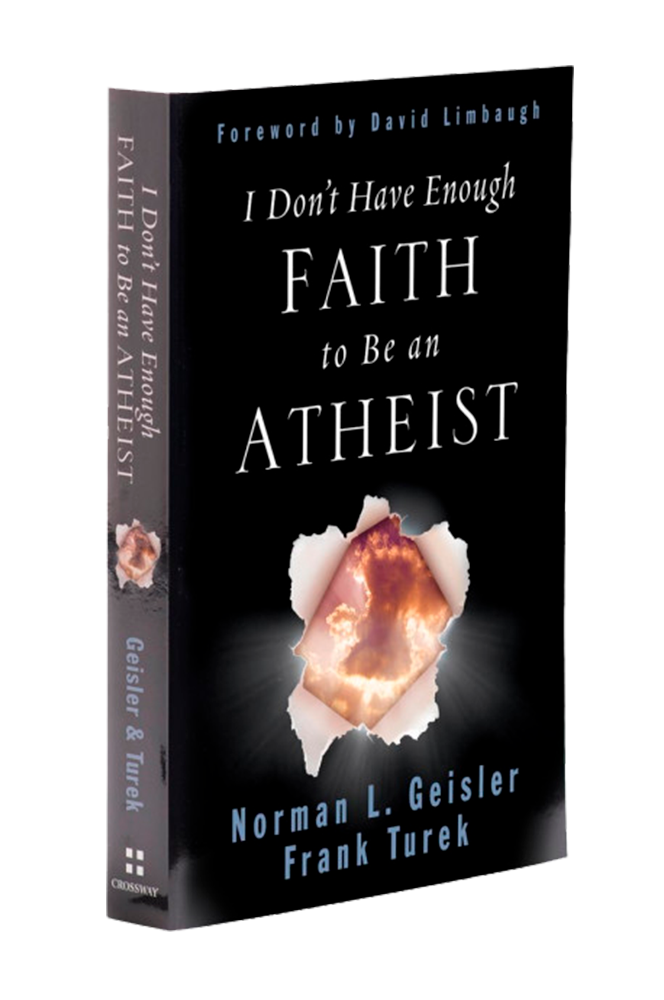
I Don’t Have Enough Faith to Be an Atheist

Reviewing a faith-building book.

For those who consider themselves atheists or agnostics, “I Don’t Have Enough Faith to Be an Atheist” by Norman L Geisler and Frank Turek, ©2004 unsettles comfortable dogma and cracks open the possibility that what you have argued against might be possible after all.   For those who are believers, this is a very affirming book, yet at the same time it is a demanding book as it requires thinking deeper than, “Scripture says it, I believe it.”  It forces us to learn why we believe it and how to defend it in discussions with those who do not believe or accept Scripture as a starting point.  If that’s where you want to go, then this is the best book I have read to take you there.  I am thankful to Michael Collins for gifting it to me and encouraging me to read it.

Why the title?

The authors point out that “every religious worldview requires faith-even the worldview that says there is no God” (p.25).   They then lead us repeatedly in each section of the book to the discovery that “Once one looks at the evidence, it takes more faith to be a non-Christian than it does to be a Christian” (p. 24).  Since they are writing both for atheists and Christians, they do not start with Scripture, but with scientific facts and logic.  They only argue from Scripture after they have built a case for its validity.  As Christians, this methodology should not disturb us since both King David (Ps. 19:1-4) and Paul (Rom. 1:19-21) argued that much could be known about God from nature itself.        

You can know there is a God by observing the world.

Chapters three through seven cover four logical arguments for the existence of God based on the observation of the universe and the nature of human life.  The cosmological argument which is explained thoroughly goes like this. 

  • Everything that had a beginning had a cause.
  • The universe had a beginning.
  • Therefore, the universe had a cause.  (p.75)

    Chapter three goes on to prove the second premise repeatedly using the acronym SURGE. 

    •  S- The Second Law of Thermodynamics says that entropy increases.  But if disorder increases over time, then looking back in time, we see order increasing toward unity. 
    • U- Scientific observation tells us that the Universe is expanding.  Then, if we look back in this time sequence, we again eventually come to unity.
    • R- In 1965, two scientists discovered Radiation by accident which was identified as the afterglow of the big bang itself.  By this Nobel-winning discovery, Penzias and Wilson also established another argument for the universe having a beginning. 
    • G- After discovering the radiation from the big bang, scientists believed that there would be ripples in that radiation which would allow for the formation of Galaxies.  In 1989 NASA launched the Cosmic Background Explorer satellite.  By 1992, it had not only proven the existence of the ripples but measured them as well.
    • E- Einstein’s theory of General Relativity had shown the interrelation of time and matter suggesting that if matter had a beginning, time may have also. 

    This is a well argued and convincing chapter that is encouraging to read.  The only part of it that I did not follow was the small and somewhat incidental discussion of the Kalam Cosmological argument (p. 90,91) which despite my strong background in university math, I found confusing.  I recommend the discussion by Dr. William Lane Craig at https://youtu.be/VeKavDdRVIg  instead for that subpoint.   

    When you observe design, you look for the designer.

    The Teleological argument, also known as the Design argument, which is covered in chapter four, goes like this.

    • Every design had a designer.
    • The universe has a highly complex design.
    • Therefore, the universe had a Designer.  (p. 95

      The more we discover how exactly the solar system and our amazing planet are tuned so that life here is possible, the more amazed we are, and the more convinced we become that so many variables all in such intricate balance could not have happened by chance.   Using the near disaster on Apollo 13 as an illustration, Geisler and Turek explain how several anthropic constants of our earth are precisely tuned to allow life to exist.  These include the percentage of oxygen in the air, the atmospheric transparency, the moon-earth gravitational interaction, the carbon dioxide level, and the earth’s gravity itself.  Of course, this is only a partial list, and the authors point out that the probability of all of them happening by accident is infinitesimal.  It makes more sense to believe in a Designer. 

      What about evolution?

      Chapters five and six tackle the issue of how life originated.  Was it created or did it evolve?  Without trying to cover it all, I found one quote that focuses the argument succinctly.

      There is a message resident in life, technically called specified complexity, that cannot be explained materially. This message cannot be explained by non-intelligent natural laws any more than the message in this book can be explained by the non-intelligent laws of ink and paper. (page 128)

      The book points out that Darwinism has a logical weakness that requires that changes be able to occur by “successive slight modifications” (Darwin’s words).  Darwin himself admitted that if organisms could be shown to be irreducibly complex, his theory would fail (p. 144).  And we now know that organisms are irreducibly complex. 

      People often object that belief in intelligent design is religiously motivated.   Our authors counter,

      A scientist’s motivation or bias doesn’t necessarily mean he’s wrong. He could have a bias and still be right. Bias or motivation isn’t the main issue – truth is… Intelligent design beliefs may be consistent with the Bible, but they are not based on the Bible. (p. 159)   

      I wrote at the top of chapter six, “fantastic chapter.”

      Our moral sense points toward a moral Creator

      The fourth logical argument is explained in chapter seven.  Since we as humans have a moral sense, we are compelled to ask where that came from.  This chapter points us back to the Creator. 

      Chapter eight is crucial in the book’s logic as it moves the argument from the existent of a First Cause and Designer who is moral to a theistic God who is at work in the world today. And it concludes that because He is the Creator, His work can include miracles. 

      Why we believe in Jesus including his resurrection.

      Chapter nine through fourteen are an apologetic for why we believe in Jesus.  If you have made it this far, the rest is not quite as logically intense but every bit as valuable. Chapters nine and ten marshal evidence that we have, both in the New Testament and in extra-Biblical sources, genuine, reliable and early testimony about Jesus.   Chapter eleven details the reasons why we can trust the New Testament authors. 

      Building on that, and drawing from other historical evidence as well, chapter twelve shows why we can confidently believe in the resurrection of Jesus.  This is a foundational subject with which every Christian should be familiar. 

      I highly recommend this book. 

      At every stage of its logic, it answers the questions people ask today and answers them thoroughly and well.  Even though it is a more intense read than some books, it will reward you by greatly strengthening your own faith.  And it will enable you to help others who are struggling to find assurance as well.  Mastery of it will help you to hold your own and be an influencer for God in discussions with those who do not have faith also. 

      This Concludes my Series on Five Excellent Books

      This Lenten season I am striving to scroll less and read more. If you are with me in this endeavor, I hope these reviews have been helpful as you choose reading material. Here are my five current recommendations listed once more for your convenience.

      Geisler, Norman L., and Frank Turek. I Don’t Have Enough Faith to Be an Atheist. Crossway, 2004.

      Maxwell, John C. The 15 Invaluable Laws of Growth: Live Them and Reach Your Potential. Center Street, 2012.

      Weissenbacher, Alan. The Brain Change Program: 6 Steps to Renew Your Mind and Transform Your Life. Broad Street, 2024.

      Groeschel, Craig. Divine Direction: 7 Decisions That Will Change Your Life. Zondervan, 2017.

      Caine, Christine. You Are Not Finished Yet: Discovering Your Purpose in the Midst of Life’s Interruptions. Thomas Nelson, 2023.

      Categories
      Best Five Journal Meditations Wisdom

      You’re Not Finished Yet

      Five Books for a Changed Life Pt. 4 and what a title!

      From the get-go this enjoyable devotional volume exudes the attitude, energy and faith of the author, Christine Caine. She is Greek by ethnicity and Aussie by country of origin. And she draws on both to add color and authenticity to her writing. For example, after explaining that both the emu and the red kangaroo which are on the Australia coat of arms are created in such a way that they physically cannot move backwards, she writes…

      The emu. The red kangaroo. And you. All created to move forward. Never backward. Let’s be who God created us to be so we can do all that He’s called us to do. (p. 9)

      Now that our author has kick-started your day – pun intentional- let’s talk about the book’s organization. The book is compactly developed with one hundred numbered two-page sections. Each begins with a title and a Bible verse, then includes corresponding thoughts from the author, and ends with a relevant prayer.

      A favorite

      One of my very favorites was number twenty-one titled “As Sure as Seedtime and Harvest.”

      The fully grown tree was always in the seed, but no one could see it until it was put in the right soil and then nurtured by the rain and the sun. In a similar fashion, the seeds in our hearts –the dreams and ideas and plans and purposes of God — grow as we …tend to the soil of our hearts, feeding them the Word of God and applying it in our lives, thus making our hearts good ground. Page 42

      Her writing is pithy and frequently very quotable like this brilliant note from number 21.

      Potential is the difference between what is actual and what is possible. It is the unexposed ability, the reserved strength, the unrealized success, the dormant gifts, the hidden talents waiting to be developed…It is where you can reach but have not yet aimed. Page 43

      A section to help us overcome

      Near the end of the book there are several devotionals on the general theme of patience and perseverance. For example, number 80 helps us understand that having faith for something does not rule out having to wait for it patiently.

      There are experiences God wants us to go through that take time so He can prepare us for the future He’s designed for us. And all of it requires we walk in both faith and patience so we can inherit everything God has for us. Page 167

      A particularly comforting note in this section was a reminder of God’s patience with us.

      Paul wrote to Timothy and said that Jesus demonstrated extraordinary patience toward him. That’s the kind of patience Jesus demonstrates toward us as well, no matter what we’re going through. No matter how we might act out. No matter if we aren’t sure what to pray, how to pray, or when to pray. He is patient with every single one of us through it all. Page 201

      Of the five books, this is likely the easiest to read, yet that does not prevent it from being deeply challenging to our spiritual walk. For example, most of us are sure that the more we adhere to our well-laid plans the farther ahead we will be. But sometimes, real progress is disturbingly counterintuitive as this excerpt points out.

      When Jesus walked on this earth, he was willing to be frequently interrupted and inconvenienced. At times we must be prepared to step aside from our own plan to truly walk in God’s purpose. Miracles are waiting in the interruption. Page 49

      Highly Recommend

      I highly recommend this book. Whether you use it for a daily devotion or read a few devotionals at a time as I did, it will certainly enrich your life.

      Five Excellent Books

      This series of five book-review posts is all about five books I have recently completed that have been highly impactful. All of us are trying to scroll less and read more so this list and the accompanying reviews are intended to help you decide what volumes might be helpful to you.

      • Maxwell, John C. The 15 Invaluable Laws of Growth: Live Them and Reach Your Potential. Center Street, 2012.
      • Weissenbacher, Alan. The Brain Change Program: 6 Steps to Renew Your Mind and Transform Your Life. Broad Street, 2024.
      • Groeschel, Craig. Divine Direction: 7 Decisions That Will Change Your Life. Zondervan, 2017.
      • Caine, Christine. You Are Not Finished Yet: Discovering Your Purpose in the Midst of Life’s Interruptions. Thomas Nelson, 2023.
      • Geisler, Norman L., and Frank Turek. I Don’t Have Enough Faith to Be an Atheist. Crossway, 2004.
      Categories
      Best Five Church Leadership Forward Look Journal Wisdom

      Five Books for a Changed Life Pt. 3

      Recent reads with insightful content and powerful personal impact

      Time to continue our series on life-changing books.  Looking for suggestions as to what to read?  This is the third post in my five-part series about some of the most impactful books that I have recently read.  I’m passing along some suggestions for your reading list or book-giving list.   The books are of different kinds, but all of them will motivate positive change in your life and in your Christian discipleship as they have done in mine.    

      • Maxwell, John C. The 15 Invaluable Laws of Growth: Live Them and Reach Your Potential. Center Street, 2012.
      • Weissenbacher, Alan. The Brain Change Program: 6 Steps to Renew Your Mind and Transform Your Life. Broad Street, 2024.
      • Groeschel, Craig. Divine Direction: 7 Decisions That Will Change Your Life. Zondervan, 2017.
      • Caine, Christine. You Are Not Finished Yet: Discovering Your Purpose in the Midst of Life’s Interruptions. Thomas Nelson, 2023.
      • Geisler, Norman L., and Frank Turek. I Don’t Have Enough Faith to Be an Atheist. Crossway, 2004.

      Divine Direction: 7 Decisions That Will Change Your Life.

      This is another eminently practical book that helps motivate us and gives us practical insights into how to navigate life.  Craig Groeschel and his wife Amy founded Life-Church which has grown into a large network of churches.  He is the author of several New York Times best-selling books, including, Winning the War in Your Mind; Change Your Thinking, Change Your Life;  Lead Like It Matters;  and The Benefit of Doubt. 

      Divine Direction begins by helping us to get in touch with the story that we all hope to write – but not just from our perspective!  We are to seek in prayer to sense what God wants for us.  Then once we have our direction in mind, the rest of the book helps us with very simple and practical tips about the choices that will help us get there.

       How to begin

      “If you want to take aim at the story you want to tell, you have to make small, life changing choices and then act on them daily. The best decision you can make is always the next one” (Page 14). “It’s the small choices no one sees that result in the big impact everyone wants” (Page 15).

      In an unusual move, typical of the simple thrust of the book, each chapter title is a single word, an action verb.  The first chapter is “Start.”   “After you have a sense of what God wants you to want, where do you begin? What discipline do you need to start practicing to head toward where God wants you to get?” (Page 40).

      Chapter two is a surprise with the title “Stop.”  In order to get something happening that is not currently, we will need to make room in our lives.  So, we need to ask another necessary question which we often neglect. “Based on what God wants you to want, what does God want you to stop?” (Page 64).

      How to keep going

      Yet, on the way to any goal, there are setbacks and times when one feels like there is no progress.  “If you are tempted to walk away, make sure to seek God, because you never know what he might do if you have the courage to stay.”(Page 87).  Chapter three titled “Stay” closes with the amazing story of Bobby Gruenewald, inventor of YouVersion App.   Bobby started and sold two technology companies before he graduated from college.  He started volunteering at his church in his mid-twenties and they put him on staff.   His pastor labeled his work as “extraordinary,” but Bobby felt he wasn’t making a difference and was tempted to quit.  But he persevered in God’s work and became the inventor of YouVersion Bible App which the church sponsored.  

      Chapter four titled “Go” is the motivational chapter we expected at the beginning.  But even so, it has some surprising nuggets of wisdom.  “Even if you don’t feel like anything is different right at this moment, it’s always a good idea to keep your heart prepared for change.  Because it happens to us all: a new step of faith, a new venture, a new opportunity” (p. 96).  Or this memo, “To step into your destiny, you might have to step away from your security” (p. 97).

      Why keep going?

      Chapter 5 called “Serve” is a great reminder of our ultimate mission.  “We forget that we are not made to be spiritual consumers.  God has called us to be spiritual contributors.  And the church does not exist for us.  We are the church, and we exist for the world” (p. 128).  That kind of thinking is why Rev. Groeschel’s church is changing the world!

      Connection with others is the topic of chapter six.  “When you decide to connect with people, you change the story you will tell one day” (p. 150).   Other people influence us and we influence them as well.  “Everyone needs a friend who makes them better” (p. 153).

      All this sounds great, but we are often fearful and hold back.  We know what is needed but sense that the journey will be too much for us.  In chapter 7 called “Trust” our author agrees that sometimes life will be more than we can handle, but he points the way in our dilemma.  It is in exactly such times that we must trust in God to help us through.  God still whispers to us as He did to Paul “My grace is sufficient for you, for my power is made perfect in weakness” (2 Cor. 12:9,10).

      I highly recommend this book 

      It is filled with touching life stories to help us understand.  And its advice is eminently practical.  It is clear the author lives the message of the book and so is well qualified to help us on our journeys.  The writing is succinct and easy to read too.       

      Categories
      Best Five Journal Wisdom

      Five Books for a Changed Life Pt. 2

      What to read next!

      All of us are trying to scroll less and read more.  But what to read?  In this second post in my series about some of the most impactful books that I have recently read, I’m passing along some suggestions for your reading list or Christmas book-giving list.    The books are of different kinds, but all of them will motivate positive change in your life and in your Christian discipleship as they have done in mine.  This is the second of five planned articles in this series with each post reviewing one book but always listing all five.

      • Maxwell, John C. The 15 Invaluable Laws of Growth: Live Them and Reach Your Potential. Center Street, 2012.
      • Weissenbacher, Alan. The Brain Change Program: 6 Steps to Renew Your Mind and Transform Your Life. Broad Street, 2024.
      • Groeschel, Craig. Divine Direction: 7 Decisions That Will Change Your Life. Zondervan, 2017.
      • Caine, Christine. You Are Not Finished Yet: Discovering Your Purpose in the Midst of Life’s Interruptions. Thomas Nelson, 2023.
      • Geisler, Norman L., and Frank Turek. I Don’t Have Enough Faith to Be an Atheist. Crossway, 2004.

      The Brain Change Program: 6 Steps to Renew Your Mind and Transform Your Life.

      Dr. Weissenbacher’s journey

      I have found that books which come from cross-discipline environments are often particularly insightful and helpful. Today’s book is one of those. Dr. Alan Weissenbacher started his education in biology and then went to seminary. After that he worked for the Denver Rescue Mission as a chaplain for the homeless, helping to move homeless and addicted people out of an urban setting to a farm and giving them tailored therapy and job training. Eventually, inspired by the struggles of his clients and desiring to improve Christian rehabilitation, Alan enrolled in a doctoral program in neuroscience and spiritual formation. This book is part of the fruitful result of the intersection of Dr. Weissenbacher’s desire to help people change and his scientific knowledge of the brain’s neuron structure.

      The Brain Change Program is relatively short and easy to read, but it will take a lifetime to fully put its wisdom into practice. It is filled with interesting illustrations from his practice as a counselor and mentor to addicts and practical advice for you and me as we tackle habits that we personally would like to change.

      Discoveries in this book

      There were some surprising discoveries in the book. For example, musicians know that they can practice without the instrument and make some progress.  Dr Weissenbacher teaches, “Your brain cannot tell the difference between imagining an action and actually doing it, so you can change your brain in your imagination as easily as you could through actual experience” (Page 18).

      Other ideas were equally as important but not so surprising.  For example, we know it helps to have encouragement from others and our author agrees.  “The more people you have on your brain change team, the more likely you are to succeed and make those positive changes permanent” (Page 23).  He identifies a couple roles played by other people as we seek change.  “We need others to help us identify the parts of ourselves in need of change and to help motivate us to make our brain changes stick” (page 25). 

      But what is the science behind all this?   This book helps us understand the science without making it sound too ivory-tower.   “The brain creates new neurons, lays down new circuits, and forms new connections and branches that carry messages to and from other neurons. At the same time, it removes unused connections and prunes dormant and unused neurons, much like the owner of a house plant will prune dead and dying leaves” (Page 27).  So, one way that our brains are constantly changing is by creating new cells and assigning them to things we are currently concentrating on.   But there is more.   “Existing neurons can also change. This is in part how we transform our brain and the actions associated with it: by exercising choice in our thoughts and behaviors. Neurons become stronger through repeated use and weakened through inattention, so we know that they are malleable. Said in another way, continually stimulating a neuron increases its ability to respond, and repeatedly neglecting the neuron weakens its ability to respond. This ability is called neuroplasticity” (Page 29).   “Like muscles, frequently used neurons get stronger, and unused neurons atrophy. They follow the, ‘use it or lose it’ concept” (Page 29). 

      There are many interesting consequences of this science.  One is that “People’s brains are uniquely shaped by their jobs. You could even say, ‘change jobs, change your brain.’ You become what you do” (Page 31).   I cannot help but think of Paul’s admonition that we be “transformed by the renewing of your mind” (Rom. 12:2).   Apparently, this is not just spiritual advice, it is quite literal.  As we form new habits of discipleship, our brain’s neurons are wired differently.   We literally become new creations modeled after Jesus.    

      Chapter 2, the title of which begins, ‘Use it or Lose it’ guides us toward some very practical tips for bringing about life changes we desire.   “The key to escaping the stronghold is not to attempt to rid yourself of the struggle through sheer willpower but rather to counter it by trying something new, preferably something healthy, productive, and enjoyable” (p. 36”).  Our author calls this tactic “addiction replacement therapy” (p. 36).  His rationale is that “this approach not only grows a new brain circuit, but it also triggers a release of dopamine, a chemical in your brain that makes us feel happy, thereby rewarding the new activity and consolidating new, neural connections” (p. 37). So, our practical strategy for habit change is this.  “Instead of resisting a bad habit, redirect and replace it with a new one” (Page  37).   And the key to long-term change is to remember that “whatever you do consistently becomes what you do automatically” (Page 39)!  Consistent behavior constructs new neural superhighways.

      Chapter 3 is about neural linking.  In other words, ‘neurons that fire together wire together.’ “When unrelated neurons forge a link as a result of repeated, associated activities, we create a triggering effect in our brain. That is, our behaviors link with specific stimuli, such as people, places, things, or emotions. As a result, these stimuli become triggers eliciting emotions, behaviors, and even memories. The stimulus and the response share a neural link, so whenever one of the neurons in the shared link fires, the neuron on the other side of the link fires too” (Page 62).  This helps us to understand patterns of behavior that are triggered by seemingly unrelated stimuli.  A smell might create a strong desire for something.  Or a sound might trigger a behavior.    How do we change such ingrained associations?  Addicts frequently face this dilemma.  “The solution to rewiring a neural link is twofold: awareness and preparation” (p. 62)  

      Sometimes all of us tend to run from our problems.  While a temporary respite may be needful, Dr. Weissenbacher warns on the basis of brain research that avoiding the issue is not a good solution.  “We have to learn to respond to hard things in positive ways to establish positive neural links. Avoiding or taking a break from our problems and emotions does not serve us. We must expose ourselves to challenging experiences so that we can train ourselves to react and behave in the ways we want and to experience the emotions we want” (Page 66).   In other words, avoiding the problem does not rewire our brains for the future.

      Five Steps to Change

      Chapter five summarizes Dr. Weissenbacher’s 6-step brain change program, which is designed to help us to make progress in our own personal development.  It especially helps with those most difficult areas- the ones complicated by half-buried traumas and stubborn bad habits.  In a nutshell, here are the steps.

      • Identify the thought or behavior that you seek to change.  Expect to find complexity.
      • Evaluate it.  Often this leads to greater self-awareness and understanding.
      • Replace, don’t resist!   “You may have to replace a negative thought or behavior again and again but keep at it. Any amount of neglecting the old thing weakens it” (P. 127). 
      • Retrain with Imagination.  Right thinking pays off too.   “The more you practice good actions in your mind, the more likely you are to convert those good actions into automatic behaviors” (p128).
      • Introduce a new element.  “Disrupt harmful, problematic neural links by introducing new, positive elements and emotions” (p. 129).

      I highly recommend this book. 

      It is a must read for leaders who counsel others. It is short and easy to read. I found this book shed very practical light on my own journey; it added concreteness to my discipleship.  It helped me identify neural links in my own life, some old and some newly forming.  Some are healthy and some need to be changed.  Sometimes our thinking about spirituality becomes rather mystical or other-worldly in an unhealthy way.  This book taught me that good spiritual disciplines are producing real world changes in me that are preparing me to better handle tomorrow. 

      Categories
      Best Five Church Leadership Journal Wisdom

      Five Books for a Changed Life

      Recent reads with insightful content and powerful personal impact

      In today’s world where we have so many choices, sometimes it’s good to have someone else help narrow the options.  In that spirit, I’m passing along recommendations for your reading list or your Christmas book-giving from some of the most impactful books that I have recently read. They are of different kinds, but all of them will motivate positive change in your life and in your Christian discipleship as they have done in mine.  I plan five articles in this series with each post briefly reviewing one. 

      • Maxwell, John C. The 15 Invaluable Laws of Growth: Live Them and Reach Your Potential. Center Street, 2012.
      • Weissenbacher, Alan. The Brain Change Program: 6 Steps to Renew Your Mind and Transform Your Life. Broad Street, 2024.
      • Groeschel, Craig. Divine Direction: 7 Decisions That Will Change Your Life. Zondervan, 2017.
      • Caine, Christine. You Are Not Finished Yet: Discovering Your Purpose in the Midst of Life’s Interruptions. Thomas Nelson, 2023.
      • Geisler, Norman L., and Frank Turek. I Don’t Have Enough Faith to Be an Atheist. Crossway, 2004.

      The 15 Invaluable Laws of Growth

      Recently I discovered on my shelf a John Maxwell book that I had not read. So, I began almost immediately, and, as usual with leadership expert Dr. Maxwell, I was richly rewarded for my efforts.  The 15 Invaluable Laws of Growth follows the general schema of his more famous book, The 21 Irrefutable Laws of Leadership: Thomas Nelson, 1998 by discussing one great principle in each chapter.  Some laws he covers, like the first, The Law of Intentionality, seem obvious but are definitely foundational ideas of which we need to be reminded. Maxwell says, “Change is inevitable. growth is optional.”  His overall goal is to motivate us to have a plan for our personal and professional growth which we attend to daily.  “Growth doesn’t just happen. You must be intentional about it.”

      Some laws Dr. Maxwell gives us are not so obvious, like the third one.  Yet, upon reflection, they are also key.   The Law of the Mirror says, “You must see value in yourself to add value to yourself!”  Here he reminds us that negative self-talk, which comes so easily in our angry times, unwittingly undermines our self-image.  By contrast, he encourages us to learn that practicing small daily disciplines builds morale (p. 45). 

      A law that I find easy to neglect is the Law of Reflection.  “Experience is not the best teacher.  Evaluated experience is!”  I learned that I should press pause more often and take time to reflect so that the lessons of experience are not wasted. 

      Many of the Laws of Growth are genuinely challenging.  How about the Law of Consistency?  “Motivation gets you going, but discipline keeps you growing.”   One seminal thought reminded me of the theme of his book Today Matters: Warner, 2004. “You will never change your life until you change something you do daily.”

      We all need some good coaching about handling our failures too.   With his characteristic humor, Maxwell says in his chapter on the Law of Pain, “A bend in the road is not the end of the road unless you fail to make the turn” (p. 132).   

      The Law of Trade-offs helps us to be realistic about many of the decisions we face.  I remember hearing John Maxwell say in person, “You have to give up to go up!”   In this chapter this idea is applied, “You have to give up to grow up.”  “The difference between where we are and where we want to be is created by the changes we are willing to make in our lives” (p. 179).  I think most of us are uncomfortable with this truth, but looking back in my own life, I can see how true it is. 

      Finally, one of the most important chapters expounds on The Law of the Ladder.  The analogy is that building our life is like ascending a ladder where the rungs represent our character.  The higher we ascend, the stronger the supporting structure, our character, must be to support us.  If our character is flawed, it is like being up too high on too flimsy a ladder.  Eventually the climber falls.  “Before you can do, you must be…Continual growth and lasting success are the result of aligning the inside and the outside of our lives” (p. 146).   

      I highly recommend this book. 

      I have read many Maxwell books, and this is one of the top three on my list.  It’s one of those books you will wish you had read years ago.  So now’s the time!

      Categories
      Church Leadership Journal Meditations Wisdom

      The Purpose of Lent

      Did you ever wonder what is the purpose of Lent? Maybe, like me, you didn’t grow up with a Lenten emphasis. In the country Wesleyan Church of my childhood, I don’t remember the church routine changing until Palm Sunday. But over my years as a pastor I began to appreciate more and more the power of the traditional Christian observance of Lent to strengthen our discipleship and deepen our spiritual journey. Now in retirement years, I am still finding Lent to be very meaningful and for multiple reasons.

      Lenten Cross

      A reminder to focus on Jesus

      Above all, Lent is a time for worship and adoration of Jesus. There are certainly all kinds of helpful topics to explore in church services and personal Bible study, but in order to keep the perspective that we need to address these other issues well, we must first keep the admonition to “fix your thoughts on Jesus” (Heb. 3:1, 12:2). Whatever methods we choose to observe the Lenten season, they will only be a real success for us if they help us to look up to God, to “draw near” to God who has promised in the midst of our seeking to draw near to us (James 4:8)! So the first question in our plans is not “How will I deny myself?” Rather the first measure for evaluating our Lenten observances is, “How do they help me/us to worship Jesus, to obey the Father’s voice, “This is my beloved Son! Listen to him” (Mark 9:7 ESV)!

      Confessing our sins is healthy renewal

      A Time of Repentance

      There is a haunting verse in the Bible that says, “In their own eyes they flatter themselves too much to detect or hate their sin” (Ps 36:2 NIV). That verse makes me uncomfortable and I am afraid it speaks of us much of the time. We quickly condemn sins we see in others while ignoring our own or excusing ourselves. But perhaps my spiritual discomfort is healthy, akin to the kind of discomfort caused by strong exercise. Remember that Jesus admonished us to “First take the plank out of your own eye! (Matt. 7:5 NIV). The good news is that observing Lent gives us space to do the hard work of confronting ourselves where we need it. To move closer to a Holy God is to become more aware of our unholiness and to find in our hearts a Spirit-birthed desire for transformation. To witness again the commitment of Jesus in his journey to the cross for our sakes is to hate our own wavering, and to renew our own commitments to following Him. In our interactions with the world around us, our Christianity loses its edge, it becomes desensitized and dulled by the assault of temptations. But Lent gives us an opportunity to hone our edge again as the Rock of Our Salvation shapes our minds and spirits with his own.

      Be prepared

      An aid in preparing for the difficult times

      Lent provides space to to delve into difficult yet important and relevant topics that we might tend to avoid if it were not for the annual call to wrestle anew with Jesus’ journey to the cross, his betrayal, his time in Gethsemane, etc. For example, recently my pastor’s Lenten message explored how we can react when God seems absent in our struggles, the thought that is voiced in Psalm 22:1 which Jesus quoted from the cross. “My God, my God, why have you forsaken me?” We all like “feel good,” “Blessed Assurance” messages, and we need them frequently, but unless we also mull over and digest the sobering lessons of Lent, we may find ourselves ill-prepared for real life with its trials, disappointments, and injustices. But Lent has a way of reminding us that life is often not ideal and then helping us deal with that brokenness.

      self control illustrated

      An annual nudge toward greater self-control

      I have also always appreciated the Lenten emphasis on self-discipline. I confess that I perennially need more of that. Though traditionally associated with fasting, I find that the scope of Lenten discipline is best broadened so the Holy Spirit can guide us as churches and individuals into the alterations of habits that will be most beneficial for us. Sometimes the goal will be a temporary one enduring just for the season; other times the idea of our Lenten discipline will be to use the season’s impetus to jumpstart us to a new level. I offer ten quick suggestions of various disciplines I have found helpful over the years while celebrating Lent. I include them to spark your own thinking.

      • Read a book that challenges my spiritual growth
      • Volunteer to help in a ministry of the church or do a community service, perhaps visit someone in a nursing home
      • Contribute to a disaster/poverty relief organization
      • Abstain from food for a meal or a few meals and spend that time in prayer
      • Add fifteen to thirty minutes to my daily devotional time
      • Keep track of calories
      • Attend additional church services such as on Good Friday and/or Easter Sunrise
      • Abstain from or limit online time and/or apps
      • Join a small group at church for growth, service, and/or study
      • Set Lenten goals for my exercise regimen

      Do not seek God as if He were far off in an ivory castle. He is found in the middle of the events of your everyday life. Look past the obstacles and find Him.

      Fenelon, The Seeking Heart, p. 15

      Categories
      Church Leadership Journal Joy Notes Meditations Wisdom

      Easter Service at Copper Hill Church

      Jesus’ Victory is Contagious was the theme

      Watch the service

      I was privileged to be asked along with my wife to speak at and lead the Easter celebration at Copper Hill church this past Sunday. Pulpit supply there has been week-to-week lately and it was great joy when supervising pastor Rev. Gene Ott called and asked if I would return for the first time since I retired to lead on Easter. So I am including a link to the service above.

      By special permission, JoAnne gathered a choir and arranged an Easter hymn titled, “That Easter Day” for us. It was a compilation of familiar hymn melodies with less familiar but beautiful Easter hymn words. JoAnne brought her harp and played “Rejoice, the Lord is King” and also brought the idle church keyboard back to life. Her piano students, Morgan and Malia Gabbidon, treated us to an inspiring piano duet of “Come Thou Almighty King.”

      My message for the day titled “Contagious Victory” reminded us that God has blessed us to be able as Christians to appropriate Jesus’ victory to our own lives. Because he was victorious, we can in his strength overcome the challenges that we face as well. My text was,

      In all these things we are more than conquerors through him who loved us.

      Romans 8:37 NIV

      The cross of Jesus appeared to be the victory of hate and envy.  But in the light of Easter, it became evident that on the cross, God’s Love had spoken an unconquerable word of loving forgiveness which would echo around the world and down through the ages.  The word “love” itself has been forever redefined by Jesus’ giving of himself.  The very concept of servant-leadership was created and exemplified in Jesus.   The love of Jesus continues to be contagious and to speak a better word as it is spread around the world through disciples like you and me!

      Jesus’ great Easter Victory is the victory of wholeness over brokenness and of righteousness over sin in our daily lives.  I observed that victory in Jesus is really a very practical thing.  As early as the writings of Moses, the Bible encourages us to follow God’s ways, “that it may go well” with us.  That connection is found seven times in Deuteronomy (Deut. 4:40; 5:16; 6:3; 6:18; 12:25; 19:13; 22:7; Jer. 7:23; Eph. 6:3).  Walking in Jesus’ ways, listening to the still small voice of the Holy Spirit as we choose our daily lifestyle, leads to a different way of living. We still have troubles, we still make mistakes, but even in them, we make better choices because those choices are influenced by Holy Scripture and its values.   The fact is that God’s ways are more wholesome ways that generally lead to life and health.  The long-term salutary effects of our Christian walk are then one very important way that we become more than conquerors through him who loved us. And… the victory that Jesus won becomes contagious in our lives.

      Jesus’ victory over death is contagious for us as well. When we stand by the casket of our loved ones, it seems like death has won again.  But the eyes of faith see differently.  The Bible says that Christians do not grieve as others do (1 Thess. 4:13). Why?  Because they can see a glimpse of the possibilities introduced by Jesus’ Day of Resurrection! 

      It is written: “I believed; therefore, I have spoken.” Since we have that same spirit of faith, we also believe and therefore speak, because we know that the one who raised the Lord Jesus from the dead will also raise us with Jesus and present us with you to himself.

      2 Corinthians 4:13-14 NIV

      The joyful conclusion is that because the resurrection power of Easter morning is also at work in us (Ephesians 1:19,20), Jesus can turn the brokenness of our lives into a fountain of grace! His victory is indeed contagious!

      Categories
      Journal News Commentary Wisdom

      How to Choose a President

      Good Character is Key

      With the first Republican candidate debate, the issues of presidential election politics became more pressing. Debate number two will intensify the voters’ dilemma. I know I am not alone when I say that I can hardly bring myself to properly prepare as a citizen because of the contentious and disappointing nature of politics in recent years. Yet, I need to. As I contemplate another election season, the question for me and I think for every voter is simple on the surface. “Who is the best candidate?” But in this era of misinformation and constant spin on everything, making that judgement seems anything but simple!

      Media-managed selection of candidates can be alluring and deceiving.

      As voters, we need some criteria to help us look past the parroted talking points, the inevitable mudslinging and the constant real-issue avoidance. However, I am very afraid that most voters judge far too shallowly. Camera image, bravado, self-assertion, and smooth talk by picture-ready candidates impress people far more than genuine credentials and honest communication. As constant consumers of media, we are so used to judging actors on their acting, it doesn’t seem to occur to us to ask whether the candidate is genuinely portraying him/herself in front of that camera. Hence TV and media personalities can get elected based on an impressive media persona which may be quite different from who they really are. And we have had a constant parade of such legislators who were quickly revealed to have no integrity and be quite undeserving of their office.

      The real threat comes from bad character.

      What we all need to remember is that citizens are not protected simply by having many police on the beat or strong armies and navies, but rather by the good moral character of their neighbors and the leaders who are over them all! Bad neighbors and bad leaders both make citizens afraid! John Maxwell, the expert on leadership today, teaches that the number one can’t-do-without characteristic of leaders is good moral character.

      “Character makes trust possible and trust is the foundation of leadership.”

      John C. Maxwell 1

      How can we recognize good character in political leaders?

      Drawing on biblical wisdom, we can flesh this out with particulars. For example, especially disqualifying characteristics include greed, 2 lawlessness,3 arrogance,4 and lack of compassion for the oppressed.5 All these traits show self-centeredness and predict a decrease in genuine concern for ordinary citizens. They also greatly increase the likelihood of misuse of power.

      Chief among favorable characteristics is a demonstrated fear of God.6 The person with this honorable trait believes they are accountable to God and therefore they desire to give a good accounting of their deeds when their own Day7 arrives. The person who fears God is in the process of learning how to live according to the teachings of God. For Christians, instructions of Jesus, such as “Love one another,”8 and “Do to others as you would have them do to you,”9 are in their mind. Such a one is more likely to value personal integrity too. They will likely develop a consistent reputation for value-driven and principle-driven decisions. These traits increase the likelihood that the leader will be genuinely considerate of citizens and benevolent in the use of power.

      This is only the beginning

      Certainly there are other important considerations in the presidential race. For example, the person chosen must be electable, not just by the party faithful, but by the country as a whole. I’m interested in how the person polls beyond the party faithful? And a candidate for presidential leadership must have the ability to draw and hold talented and wise helpers and advisors. How are they handling their campaign team, for example, because leading leaders is the stuff of presidential life.

      Yet, despite all these complexities, good character remains the bottom line.

      So I consider it my first job as a voter to try to learn about the character of the candidates. I am interested in their positions on issues too, of course. But character is first! When I read or watch news, when I view a debate, the most important information that I am seeking concerns the character of the candidates. Character is key to everything!

      1. The 21 Irrefutable Laws of Leadership, p. 9, Thomas Nelson Inc. 2012 ↩︎
      2. “The love of money is a root of all kinds of evil” 1 Timothy 6:10 ↩︎
      3. “When the wicked thrive, so does sin.” Prov. 29:16 ↩︎
      4. The biblical Psalmist describes the wicked this way. “They scoff, and speak with malice; with arrogance they threaten oppression.” Psalm 73:8 ↩︎
      5. “The righteous care about justice for the poor, but the wicked have no such concern.” Prov. 29:7 ↩︎
      6. “The fear of the Lord is the beginning of wisdom.” Psalm 110:10
        “Through the fear of the Lord evil is avoided.” Prov. 16:6 ↩︎
      7. “”Each of us will give an account of ourselves to God.” Rom. 14:12 ↩︎
      8. John 13:34 ↩︎
      9. Luke 6:31 ↩︎
      Categories
      Journal Meditations Wisdom

      Why go to Church

      Thought for a Sunday

      People-watching statisticians are telling us that more people are choosing to do other things on Sunday morning besides go to church. There are lots of choices from a trip to the beach to the ever-expanding Sunday sports schedule. But even among those who still prioritize a worship experience on the weekend, many are choosing online options for worship. Recently I attended a local church that listed the attendance for the previous week both in-person and online. Online attendance was a full third of in-person attendance. Of course, the availability of online worship is a huge help to many who could not otherwise attend for a variety of reasons. Yet I found when I was on vacation myself that tuning in could also be a choice of ease rather than necessity. Hmm.

      All this requires us to ask ourselves again why we attend service at church in the first place. This morning before church, I was reading in the book of Haggai, a short Old Testament book recording the words of a prophet who spoke to people who were trying to get along without rebuilding their Jewish Temple. The folks in his audience had returned to Israel from exile and were building their own houses with great success (Haggai 1:4). Yet they had put forth no effort to rebuild the house of God. However, rebuilding the temple was the very reason they had been allowed to return from exile (2 Chron. 36:23). During his conversation, Haggai gives us some great reasons to worship God in-person at the local house of God whenever we can. The verse that instructed me was this one.

      Go up into the mountains and bring down timber and build my house, so that I may take pleasure in it and be honored,” says the Lord.

      Haggai 1:8

      I was reminded that we are always thinking from our perspective, how we like it, how the service impresses us. But God takes pleasure in his house and by implication in the worship that happens there. God reminded the people that one purpose for them being in the temple was to honor Him. I remember a friend in Kirkville who was playing golf one Sunday morning. He later testified at church that it was as if God spoke to him saying that God would be honored best by my friend’s presence in worship at church. From then on he determined to be at church on Sunday morning to honor God. It’s not about our pleasure in the singing though we do enjoy it. It’s not primarily about us feeling inspired though we do. Rather, it is about giving honor to God by our presence and participation in worship.

      That is a perspective we need to meditate upon and take to heart!

      Categories
      Americana Journal Wisdom

      Why have a 4th of July church service?

      Celebrating the Fourth of July in the traditional way with patriotic hymns and maybe even the Pledge of Allegiance might raise questions these days. Is it too secular? Maybe even partisan? Or just distracting?

      I have always felt very positive about a traditional Fourth of July service. I even find them inspiring.

      • First, a Fourth of July emphasis keeps the Sunday service relevant on a holiday weekend in the same way that we make services relevant for other national holidays such as Mother’s Day, Memorial Day, Martin Luther King Day, and Thanksgiving Sunday.
      • A song such as “America” which I nearly always choose is itself a prayer and very appropriate for a church service.
      • The Pledge Allegiance to the American Flag seems really to be an affirmation that we will do what we are commanded to do in 1 Peter 2:13, to submit ourselves to the human authority which is over us.
      • The phrase “under God” in the Pledge of Allegiance reminds us that our first allegiance is to God. When I use the Pledge to the American Flag in a service, I also use the Pledge to the Christian Flag. And I do the latter one first, noting that our first allegiance is to Jesus.
      • A Fourth of July service with patriotic overtones pays tribute to the Christian heritage of our country’s beginnings. Connecticut was founded by the Congregationalists from Massachusetts and had an established church until about 1818. We don’t wish to return to that but we do want to remember their legacy. In 1892 the Supreme Court declared, “Our laws and our institutions must necessarily be based upon and embody the teachings of the Redeemer of mankind.  It is impossible that it should be otherwise; and in this sense and to this extent our civilization and our institutions are emphatically Christian” (Church of the Holy Trinity V. Unites States). So, there is a close interrelationship between the values espoused in our country’s great documents such as the Declaration of Independence and the Christian faith that partially inspired them. A Fourth of July service reminds me of this linkage.