Categories
Best Five Journal Wisdom

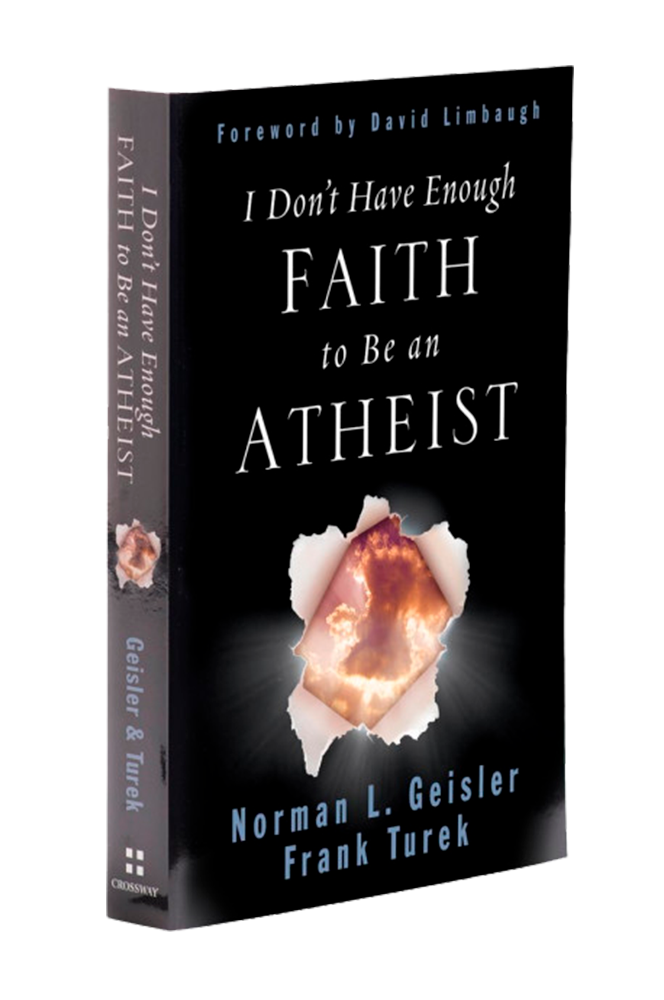
I Don’t Have Enough Faith to Be an Atheist

Reviewing a faith-building book.

For those who consider themselves atheists or agnostics, “I Don’t Have Enough Faith to Be an Atheist” by Norman L Geisler and Frank Turek, ©2004 unsettles comfortable dogma and cracks open the possibility that what you have argued against might be possible after all.   For those who are believers, this is a very affirming book, yet at the same time it is a demanding book as it requires thinking deeper than, “Scripture says it, I believe it.”  It forces us to learn why we believe it and how to defend it in discussions with those who do not believe or accept Scripture as a starting point.  If that’s where you want to go, then this is the best book I have read to take you there.  I am thankful to Michael Collins for gifting it to me and encouraging me to read it.

Why the title?

The authors point out that “every religious worldview requires faith-even the worldview that says there is no God” (p.25).   They then lead us repeatedly in each section of the book to the discovery that “Once one looks at the evidence, it takes more faith to be a non-Christian than it does to be a Christian” (p. 24).  Since they are writing both for atheists and Christians, they do not start with Scripture, but with scientific facts and logic.  They only argue from Scripture after they have built a case for its validity.  As Christians, this methodology should not disturb us since both King David (Ps. 19:1-4) and Paul (Rom. 1:19-21) argued that much could be known about God from nature itself.        

You can know there is a God by observing the world.

Chapters three through seven cover four logical arguments for the existence of God based on the observation of the universe and the nature of human life.  The cosmological argument which is explained thoroughly goes like this. 

  • Everything that had a beginning had a cause.
  • The universe had a beginning.
  • Therefore, the universe had a cause.  (p.75)

    Chapter three goes on to prove the second premise repeatedly using the acronym SURGE. 

    •  S- The Second Law of Thermodynamics says that entropy increases.  But if disorder increases over time, then looking back in time, we see order increasing toward unity. 
    • U- Scientific observation tells us that the Universe is expanding.  Then, if we look back in this time sequence, we again eventually come to unity.
    • R- In 1965, two scientists discovered Radiation by accident which was identified as the afterglow of the big bang itself.  By this Nobel-winning discovery, Penzias and Wilson also established another argument for the universe having a beginning. 
    • G- After discovering the radiation from the big bang, scientists believed that there would be ripples in that radiation which would allow for the formation of Galaxies.  In 1989 NASA launched the Cosmic Background Explorer satellite.  By 1992, it had not only proven the existence of the ripples but measured them as well.
    • E- Einstein’s theory of General Relativity had shown the interrelation of time and matter suggesting that if matter had a beginning, time may have also. 

    This is a well argued and convincing chapter that is encouraging to read.  The only part of it that I did not follow was the small and somewhat incidental discussion of the Kalam Cosmological argument (p. 90,91) which despite my strong background in university math, I found confusing.  I recommend the discussion by Dr. William Lane Craig at https://youtu.be/VeKavDdRVIg  instead for that subpoint.   

    When you observe design, you look for the designer.

    The Teleological argument, also known as the Design argument, which is covered in chapter four, goes like this.

    • Every design had a designer.
    • The universe has a highly complex design.
    • Therefore, the universe had a Designer.  (p. 95

      The more we discover how exactly the solar system and our amazing planet are tuned so that life here is possible, the more amazed we are, and the more convinced we become that so many variables all in such intricate balance could not have happened by chance.   Using the near disaster on Apollo 13 as an illustration, Geisler and Turek explain how several anthropic constants of our earth are precisely tuned to allow life to exist.  These include the percentage of oxygen in the air, the atmospheric transparency, the moon-earth gravitational interaction, the carbon dioxide level, and the earth’s gravity itself.  Of course, this is only a partial list, and the authors point out that the probability of all of them happening by accident is infinitesimal.  It makes more sense to believe in a Designer. 

      What about evolution?

      Chapters five and six tackle the issue of how life originated.  Was it created or did it evolve?  Without trying to cover it all, I found one quote that focuses the argument succinctly.

      There is a message resident in life, technically called specified complexity, that cannot be explained materially. This message cannot be explained by non-intelligent natural laws any more than the message in this book can be explained by the non-intelligent laws of ink and paper. (page 128)

      The book points out that Darwinism has a logical weakness that requires that changes be able to occur by “successive slight modifications” (Darwin’s words).  Darwin himself admitted that if organisms could be shown to be irreducibly complex, his theory would fail (p. 144).  And we now know that organisms are irreducibly complex. 

      People often object that belief in intelligent design is religiously motivated.   Our authors counter,

      A scientist’s motivation or bias doesn’t necessarily mean he’s wrong. He could have a bias and still be right. Bias or motivation isn’t the main issue – truth is… Intelligent design beliefs may be consistent with the Bible, but they are not based on the Bible. (p. 159)   

      I wrote at the top of chapter six, “fantastic chapter.”

      Our moral sense points toward a moral Creator

      The fourth logical argument is explained in chapter seven.  Since we as humans have a moral sense, we are compelled to ask where that came from.  This chapter points us back to the Creator. 

      Chapter eight is crucial in the book’s logic as it moves the argument from the existent of a First Cause and Designer who is moral to a theistic God who is at work in the world today. And it concludes that because He is the Creator, His work can include miracles. 

      Why we believe in Jesus including his resurrection.

      Chapter nine through fourteen are an apologetic for why we believe in Jesus.  If you have made it this far, the rest is not quite as logically intense but every bit as valuable. Chapters nine and ten marshal evidence that we have, both in the New Testament and in extra-Biblical sources, genuine, reliable and early testimony about Jesus.   Chapter eleven details the reasons why we can trust the New Testament authors. 

      Building on that, and drawing from other historical evidence as well, chapter twelve shows why we can confidently believe in the resurrection of Jesus.  This is a foundational subject with which every Christian should be familiar. 

      I highly recommend this book. 

      At every stage of its logic, it answers the questions people ask today and answers them thoroughly and well.  Even though it is a more intense read than some books, it will reward you by greatly strengthening your own faith.  And it will enable you to help others who are struggling to find assurance as well.  Mastery of it will help you to hold your own and be an influencer for God in discussions with those who do not have faith also. 

      This Concludes my Series on Five Excellent Books

      This Lenten season I am striving to scroll less and read more. If you are with me in this endeavor, I hope these reviews have been helpful as you choose reading material. Here are my five current recommendations listed once more for your convenience.

      Geisler, Norman L., and Frank Turek. I Don’t Have Enough Faith to Be an Atheist. Crossway, 2004.

      Maxwell, John C. The 15 Invaluable Laws of Growth: Live Them and Reach Your Potential. Center Street, 2012.

      Weissenbacher, Alan. The Brain Change Program: 6 Steps to Renew Your Mind and Transform Your Life. Broad Street, 2024.

      Groeschel, Craig. Divine Direction: 7 Decisions That Will Change Your Life. Zondervan, 2017.

      Caine, Christine. You Are Not Finished Yet: Discovering Your Purpose in the Midst of Life’s Interruptions. Thomas Nelson, 2023.

      Categories
      Best Five Journal Wisdom

      Five Books for a Changed Life Pt. 2

      What to read next!

      All of us are trying to scroll less and read more.  But what to read?  In this second post in my series about some of the most impactful books that I have recently read, I’m passing along some suggestions for your reading list or Christmas book-giving list.    The books are of different kinds, but all of them will motivate positive change in your life and in your Christian discipleship as they have done in mine.  This is the second of five planned articles in this series with each post reviewing one book but always listing all five.

      • Maxwell, John C. The 15 Invaluable Laws of Growth: Live Them and Reach Your Potential. Center Street, 2012.
      • Weissenbacher, Alan. The Brain Change Program: 6 Steps to Renew Your Mind and Transform Your Life. Broad Street, 2024.
      • Groeschel, Craig. Divine Direction: 7 Decisions That Will Change Your Life. Zondervan, 2017.
      • Caine, Christine. You Are Not Finished Yet: Discovering Your Purpose in the Midst of Life’s Interruptions. Thomas Nelson, 2023.
      • Geisler, Norman L., and Frank Turek. I Don’t Have Enough Faith to Be an Atheist. Crossway, 2004.

      The Brain Change Program: 6 Steps to Renew Your Mind and Transform Your Life.

      Dr. Weissenbacher’s journey

      I have found that books which come from cross-discipline environments are often particularly insightful and helpful. Today’s book is one of those. Dr. Alan Weissenbacher started his education in biology and then went to seminary. After that he worked for the Denver Rescue Mission as a chaplain for the homeless, helping to move homeless and addicted people out of an urban setting to a farm and giving them tailored therapy and job training. Eventually, inspired by the struggles of his clients and desiring to improve Christian rehabilitation, Alan enrolled in a doctoral program in neuroscience and spiritual formation. This book is part of the fruitful result of the intersection of Dr. Weissenbacher’s desire to help people change and his scientific knowledge of the brain’s neuron structure.

      The Brain Change Program is relatively short and easy to read, but it will take a lifetime to fully put its wisdom into practice. It is filled with interesting illustrations from his practice as a counselor and mentor to addicts and practical advice for you and me as we tackle habits that we personally would like to change.

      Discoveries in this book

      There were some surprising discoveries in the book. For example, musicians know that they can practice without the instrument and make some progress.  Dr Weissenbacher teaches, “Your brain cannot tell the difference between imagining an action and actually doing it, so you can change your brain in your imagination as easily as you could through actual experience” (Page 18).

      Other ideas were equally as important but not so surprising.  For example, we know it helps to have encouragement from others and our author agrees.  “The more people you have on your brain change team, the more likely you are to succeed and make those positive changes permanent” (Page 23).  He identifies a couple roles played by other people as we seek change.  “We need others to help us identify the parts of ourselves in need of change and to help motivate us to make our brain changes stick” (page 25). 

      But what is the science behind all this?   This book helps us understand the science without making it sound too ivory-tower.   “The brain creates new neurons, lays down new circuits, and forms new connections and branches that carry messages to and from other neurons. At the same time, it removes unused connections and prunes dormant and unused neurons, much like the owner of a house plant will prune dead and dying leaves” (Page 27).  So, one way that our brains are constantly changing is by creating new cells and assigning them to things we are currently concentrating on.   But there is more.   “Existing neurons can also change. This is in part how we transform our brain and the actions associated with it: by exercising choice in our thoughts and behaviors. Neurons become stronger through repeated use and weakened through inattention, so we know that they are malleable. Said in another way, continually stimulating a neuron increases its ability to respond, and repeatedly neglecting the neuron weakens its ability to respond. This ability is called neuroplasticity” (Page 29).   “Like muscles, frequently used neurons get stronger, and unused neurons atrophy. They follow the, ‘use it or lose it’ concept” (Page 29). 

      There are many interesting consequences of this science.  One is that “People’s brains are uniquely shaped by their jobs. You could even say, ‘change jobs, change your brain.’ You become what you do” (Page 31).   I cannot help but think of Paul’s admonition that we be “transformed by the renewing of your mind” (Rom. 12:2).   Apparently, this is not just spiritual advice, it is quite literal.  As we form new habits of discipleship, our brain’s neurons are wired differently.   We literally become new creations modeled after Jesus.    

      Chapter 2, the title of which begins, ‘Use it or Lose it’ guides us toward some very practical tips for bringing about life changes we desire.   “The key to escaping the stronghold is not to attempt to rid yourself of the struggle through sheer willpower but rather to counter it by trying something new, preferably something healthy, productive, and enjoyable” (p. 36”).  Our author calls this tactic “addiction replacement therapy” (p. 36).  His rationale is that “this approach not only grows a new brain circuit, but it also triggers a release of dopamine, a chemical in your brain that makes us feel happy, thereby rewarding the new activity and consolidating new, neural connections” (p. 37). So, our practical strategy for habit change is this.  “Instead of resisting a bad habit, redirect and replace it with a new one” (Page  37).   And the key to long-term change is to remember that “whatever you do consistently becomes what you do automatically” (Page 39)!  Consistent behavior constructs new neural superhighways.

      Chapter 3 is about neural linking.  In other words, ‘neurons that fire together wire together.’ “When unrelated neurons forge a link as a result of repeated, associated activities, we create a triggering effect in our brain. That is, our behaviors link with specific stimuli, such as people, places, things, or emotions. As a result, these stimuli become triggers eliciting emotions, behaviors, and even memories. The stimulus and the response share a neural link, so whenever one of the neurons in the shared link fires, the neuron on the other side of the link fires too” (Page 62).  This helps us to understand patterns of behavior that are triggered by seemingly unrelated stimuli.  A smell might create a strong desire for something.  Or a sound might trigger a behavior.    How do we change such ingrained associations?  Addicts frequently face this dilemma.  “The solution to rewiring a neural link is twofold: awareness and preparation” (p. 62)  

      Sometimes all of us tend to run from our problems.  While a temporary respite may be needful, Dr. Weissenbacher warns on the basis of brain research that avoiding the issue is not a good solution.  “We have to learn to respond to hard things in positive ways to establish positive neural links. Avoiding or taking a break from our problems and emotions does not serve us. We must expose ourselves to challenging experiences so that we can train ourselves to react and behave in the ways we want and to experience the emotions we want” (Page 66).   In other words, avoiding the problem does not rewire our brains for the future.

      Five Steps to Change

      Chapter five summarizes Dr. Weissenbacher’s 6-step brain change program, which is designed to help us to make progress in our own personal development.  It especially helps with those most difficult areas- the ones complicated by half-buried traumas and stubborn bad habits.  In a nutshell, here are the steps.

      • Identify the thought or behavior that you seek to change.  Expect to find complexity.
      • Evaluate it.  Often this leads to greater self-awareness and understanding.
      • Replace, don’t resist!   “You may have to replace a negative thought or behavior again and again but keep at it. Any amount of neglecting the old thing weakens it” (P. 127). 
      • Retrain with Imagination.  Right thinking pays off too.   “The more you practice good actions in your mind, the more likely you are to convert those good actions into automatic behaviors” (p128).
      • Introduce a new element.  “Disrupt harmful, problematic neural links by introducing new, positive elements and emotions” (p. 129).

      I highly recommend this book. 

      It is a must read for leaders who counsel others. It is short and easy to read. I found this book shed very practical light on my own journey; it added concreteness to my discipleship.  It helped me identify neural links in my own life, some old and some newly forming.  Some are healthy and some need to be changed.  Sometimes our thinking about spirituality becomes rather mystical or other-worldly in an unhealthy way.  This book taught me that good spiritual disciplines are producing real world changes in me that are preparing me to better handle tomorrow. 

      Categories
      Best Five Journal Who Am I Wisdom

      Top Ten Books Challenge

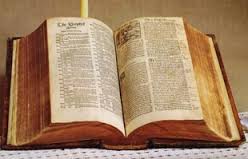
      One of the first Bibles in English
      One of the first Bibles in English

      My wife challenged me on Facebook to list the top ten books that have influenced my life. I don’t necessarily take up every Facebook fad. But this one I consider a very thoughtful and potentially helpful exercise. One of the proverbs I heard along the way is “Leaders are readers!”   I agree totally. This challenge is also in keeping with one of the goals of my blog, to record the books I have read and comment on them. So here goes:


      The Holy Bible – KJV Thompson Chain Reference.   I was given this for Christmas by my parents when I was about 12 years old. It represents the Bible-learning culture in which I was raised. It was my earliest textbook for studying the Bible. I still treasure it and use it occasionally.

      The Holy Bible – NIV 1984. This version of the Bible became the translation that I read day after day, the version that molded my mindset and helped me communicate the Gospel to a generation that had never heard of King James of England, nor did they understand his language. Now I read and use the 2011 NIV since I follow the Reformation principle that the Bible must be in the language of the people. But the 1984 version will always be in my heart.

      Growing Spiritually – E. Stanley Jones. I was in seminary, I think, when I read this devotional classic. I was captured and challenged by the practical Wesleyan theology, poignant illustration from life, and excellent thinking by one who has become one of my favorite devotional writers. This book prompted a definite step forward in my own spiritual growth.

      Developing the Leaders around You – John C. Maxwell.   During my first pastorate I began to be mentored by the speaking and writing of John Maxwell. I didn’t know how much I needed it. I now have a dozen of his books that I have read and I still consider this one among his very best. I also have a shelf full of others on the topic of leadership. This book started me on a whole different journey of not just doing well myself, but enabling others to do well. This intentional focus as well as trying to teach church leaders to do the same has added untold dimensions to my ministry and extended its effectiveness many years. It has enabled me to be a factor in launching or enhancing the ministry of many others too.

      Communication: Key to Your Marriage – H. Norman Wright.  With this book there was a companion volume The Pillars of Your Marriage.  They were not deep, but they were practical. They were intended for class use and included discussion questions too. I interacted with these books and other similar ones at a time in our marriage when I desperately needed to learn more about how to have a successful marriage. They were very helpful both to me personally and in my ministry over the years to others.

      Secrets of the Vine – Bruce Wilkinson. Sometimes you are looking for books that will prod spiritual renewal in your life. This is such a book. I have now read the book at least three times. The first time I read it, I wrote in the cover, “I finished this book today…it was a life-changing experience.”

      The 21 Irrefutable Laws of Leadership – John C. Maxwell.   This is John Maxwell’s classic. It has helped me immensely to understand leadership and learn to practice it. I am still learning and growing.   This book confirmed for me that leadership is one of the three most essential areas of understanding/preparation needed by pastors. (The other two are preaching/teaching and counseling/personal work.)

      Fresh Faith – Jim Cymbala. One of the areas I needed to grow spiritually as a pastor was faith. Reading Jim Cymbala’s testimony-laced books is one of the ways God has helped me to do that. It is challenging and inspiring to read what God is doing at Brooklyn Tabernacle and it makes one pray for greater faith.

      Just Walk Across the Room – Bill Hybels. Another of the great mentors for pastors today is Bill Hybels. This book is among his best. It is such a practical and everyday approach to reaching other people for Jesus.   I think it is evangelism as it was meant to be. It has helped me to look for opportunities daily to be a blessing for Jesus’ sake.

      The Purpose Drive Church – Rick Warren.   I had already been a pastor for 15 years when I read this book. I immediately said that it was the best book on how to do church that I had ever read. As far as I am concerned, it has not had a rival until Andy Stanley’s Deep and Wide came out in 2012.  Warren helped me to understand that discipleship was crucial and that I needed to help people step by step to move closer to the church as a part of their spiritual journey.

      I’ve read so many books over the years that I can’t be sure I haven’t missed one somewhere. I reduced my library by more than half when I moved in 2013 and I still have four floor-to-ceiling bookshelves full in my office. I have tried to choose books for my top ten that represented important areas of reading. The best books often prompt us to read more by the same author or more in that subject area. All of these books have done that. And I keep buying new books and reading more.    I admit that the time I now spend on social media has cut into my reading time, but it has not eliminated it. I am still completing new books! How about you?


      Categories
      Journal

      Library thinned

      Books to give away to mentees
      Books to give away to mentees

      I’ve completed thinning out my library according to the guidelines I published earlier.  Several associates, teachers and mentees have perused the boxes.   Some books were displayed on our yard sale as well.  However, few lookers took more than a small handful.   Seems like I remember coming away from such opportunities 20 years ago with armloads.  But the internet, the availability of cheap books and the busyness of contemporary life has created a different day.  So far JoAnne and I are finding that the demand for used books is very small.   A few classic authors were still desired.  But most who looked at the books said they already had too many books and didn’t have room for more.  There will still be opportunity to look over some of my books of books for a couple days.  I will probably start disposing of them early this next week so I can start packing the shelved ones to go to CT.

      Categories
      Journal Who Am I Wisdom

      Chronicling the reading habit

      Reading is an important habit for all of us. Of course, our number one book to read is the Bible.   I have several ways to keep track of my reading.   When I finish a book that I own, I write the date in the front. Since I started blogging, I also try to write a short article for the book review section of my blog for each book that I have read, including the borrowed ones.   I have missed one or two.    My wife keeps notes including actual quotes in her computer from each book that she reads.    This is especially helpful to her as it preserves usable material from books she has read out of the public library. 

      Both JoAnne and I always have several books going at once.   Inevitably, some get neglected while others take priority. This is just part of the way it is.   But eventually, most of them get finished.   Summer is a great time for reading.  I always manage to finish several books, as I did this year.   You can catch the three recent reviews in my book review section.

      Choosing books to read is the heart of the matter.  I try to choose books that enrich the work that I’m doing.    And I usually have at least three different areas going at once to provide variety.   Often one is for fun or for my health.   I highly recommend the discipline of reading.  Whether it is from physical books or on electronic screens does not matter.

      I usually have at least one book that challenges or encourages my spiritual life and/or my prayer life. This is a discipline I have maintained for many years.   The recent biography of Smith Wigglesworth was such a book.    Other books, I read to help me in my various responsibilities like the Gary McIntosh’s book on Taking Your Church to the Next Level.  Currently I am reading a book about college administration that is related to my work as a trustee at Houghton College.   Over the last several years, I have usually had at least one book related to leadership on my shelf with a bookmark part way through it.     For example, I finished a John Maxwell book last winter on being a people person (I haven’t reviewed it for my blog yet).  


      Categories
      Church Leadership Journal Wisdom

      Book recommendations for marriages in troubled times

      Last Sunday I finished the series of sermons called Kitchen Table Talks on Relationships.  As I was studying for the series and reviewing various sourcebooks, I was thinking about which ones to recommend to couples who were going through difficult times in their marriages.   My wife and I know from personal experience that marriage is not always easy. But we also know that with God’s help, and determination to see it through, couples can come through rough waters with a better marriage than before.   To help couples who are currently in those tough moments, here are three book recommendations.   

      Making Love Last Forever by Gary Smalley (Word Publishing, 1996)  In this easy-to-read book, Dr. Smalley handles some difficult topics such as unresolved anger, deep hurts,  disappointed expectations,  marital communication and personality differences with insight and Christian wisdom.  Taking his advice seriously will help couples get back on track.

      The Seven Principles for Making Marriage Work  (Three Rivers Press, New York, 1999)  This is a different kind of book, an extremely practical and behavior-oriented book in which the author shares his research in predicting divorce and helping couples avoid it. He describes how he predicts whether a marital conflict will resolve the problem 96% of the time after only listening to 3 minutes of it.     I was skeptical until I began to read the signs he looks for, one of which is the presence of the deadly four horsemen:  criticism, contempt, defensiveness, and stonewalling.   I knew from personal experience with couples and from other reading that he was being very insightful and his work would be helpful.   

      Fighting for Your Marriage by Howard Markham, Scott Stanley, and Susan L. Blumberg  (Jossey-Bass, San Francisco, 1994)   This book has become a classic for its description of four negative patterns that are very harmful in a relationship, patterns that must be avoided if marriages are to be healed. The authors describe the patterns well including case study examples, explanations, and practical advice as to how to change the pattern.  The four specific patterns are escalation, invalidation, withdrawal and avoidance, and negative interpretations.  When these patterns are present in the emotional interaction in a marriage they are very destructive and need to be fixed in order for the marriage to recover. This book can be very helpful in eliminating these four patterns.

      Categories
      Journal Wisdom

      Book Recommendations on Dealing with Our Anger

      This week’s continuation of the sermon series Kitchen Table Talks on Relationships dealt with the subject of anger in our relationships.   I did not have a chance to mention the resource books I wanted to recommend.  

      One of the books I recommended last week; Making Love Last Forever by Gary Smalley (Word Publishing 1996) has several chapters relating to anger issues as well.  Chapter 3, for example is titled “Seven Ways to Unload Unresolved Anger.” 

      Another small yet very helpful book is Coping with Your Anger by Andrew D. Lester (Westminster Press, 1983)   It is available either new or used from Amazon.

      A third book I recommend is Overcoming Hurts and Anger by Dwight L. Carlson (Harvest House).   The version I have is dated 1981 but I discovered that it is now available in a newer 2000 revised and expanded edition. 

      Categories
      Journal News Commentary

      Is the idea of library becoming obsolete?

      Yesterday, I was looking for a fact that I had used before concerning the early Greek documents of the Bible.  I walked from shelf to shelf in the library lining my office but did not see what I was looking for.  Mildly irritated that I could not find it quickly, I initiated a Google search and found information even more up-to-date than what I had been looking for in my library.  I stopped momentarily to reflect on what had just happened. It occurred to me that what was happening on my desk through the computer and the Internet was rendering my library, painstakingly collected over decades, obsolete.  I thought about the Greek and Hebrew references that I seldom use because I can access similar versions stored on my hard drive much more quickly.  

      Today, on the news, I read an article that may well report the trend that will be the stake in the heart of libraries like mine and maybe bigger ones too.   

      http://www.msnbc.msn.com/id/43093477/ns/business-retail/

      The news reported that Amazon is now selling more electronic books than physical books and this only four years after they started selling electronic books.  This means the transition from physical books that you hold to versions that you watch on the screen is accelerating more than we had imagined.

      I stop to think a little about what this means. What will happen to the thousands of books that people like me have collected? Will no one want them– preferring instead electronic versions?  Will there be no bookshelves in houses–only screens? Will libraries become simply banks of computer servers rather than repositories of actual books? Certainly the transition that this marks is epochal.